Official pages end in .dswd.gov.ph. Never pay to claim a benefit. Report scams to 1343.
7 programs across 3 categories
Financial Assistance
3 programs
AICS
Assistance to Individuals in Crisis Situation
Emergency financial aid for individuals and families in crisis
Who Qualifies: Walk-in, rescued, or referred clients assessed by a DSWD social worker. Any individual or family with no adequate means for medical, transportation, burial, or other urgent needs, including abandoned, abused, or exploited adults and children, regardless of income classification.
Program Description
AICS is DSWD's social safety-net program providing financial, material, psychosocial, and referral assistance to individuals and families facing a crisis situation beyond their capacity to cope. It is operated through the Crisis Intervention Unit (CIU) at DSWD Central Office, all Field Offices, and satellite offices in high-demand areas, and is currently governed by Memorandum Circular No. 16, series of 2022 (Revised Guidelines on AICS Implementation). Nationally, assistance amount and type are assessed case-by-case rather than a fixed schedule; the typical ranges below reflect DSWD FO3's standard amounts under current MC guidelines. A related program, AKAP (Ayuda para sa Kapos ang Kita Program), is also processed through the crisis-intervention counters and satellite offices.
Coverage & Benefits
Type
Amount / Details
Medical Assistance
Typically up to PHP 20,000 (case-by-case)
Burial Assistance
Typically up to PHP 10,000 (case-by-case)
Educational Assistance
Typically up to PHP 5,000 (case-by-case)
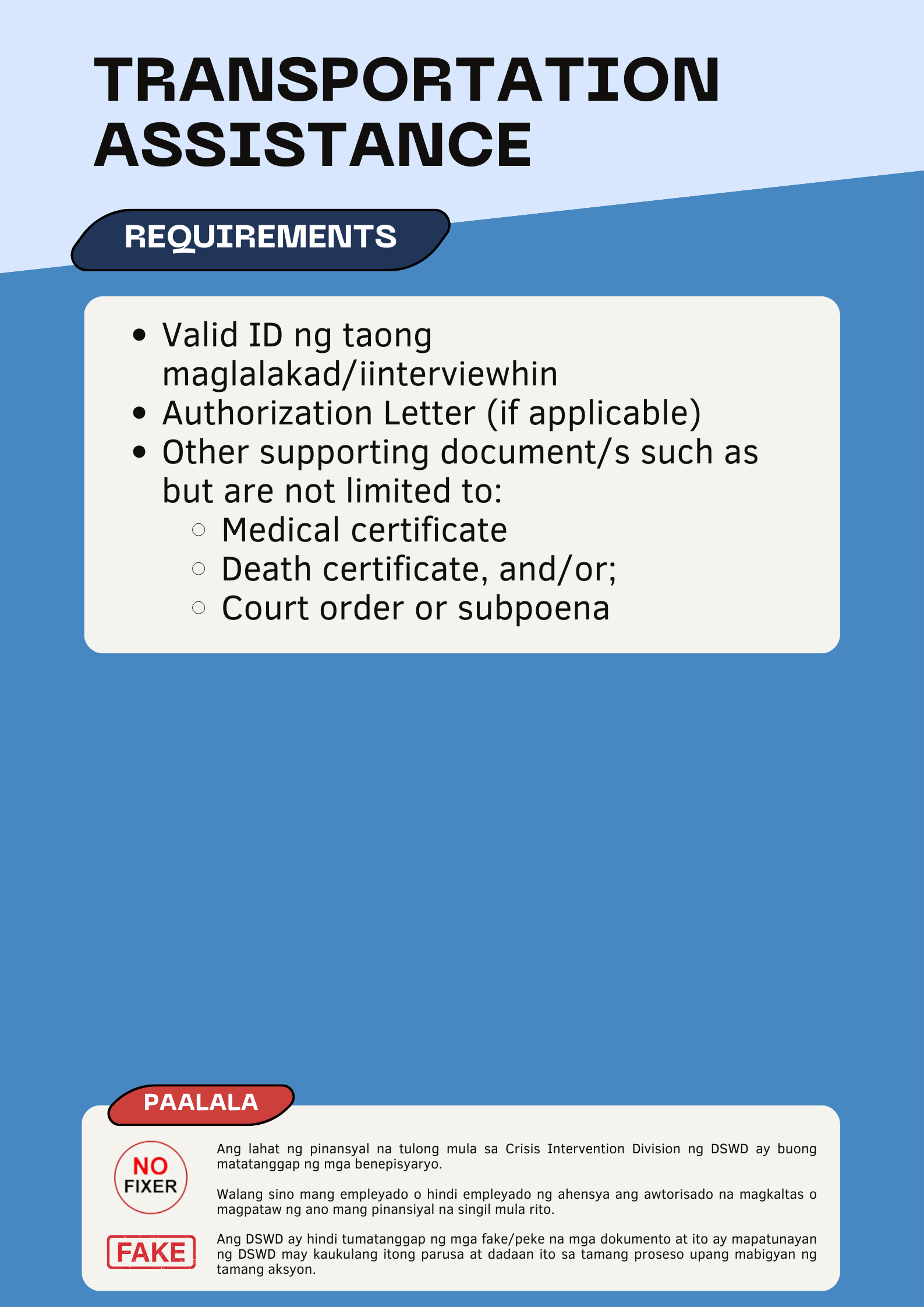
Transportation Assistance
Case-based evaluation
Other Emergency Needs
Per DSWD MC No. 16, s. 2022
Important Note: AICS is available to all individuals in crisis regardless of whether they are in the Listahanan database. Walk-in applicants with complete documents may receive same-day assessment.
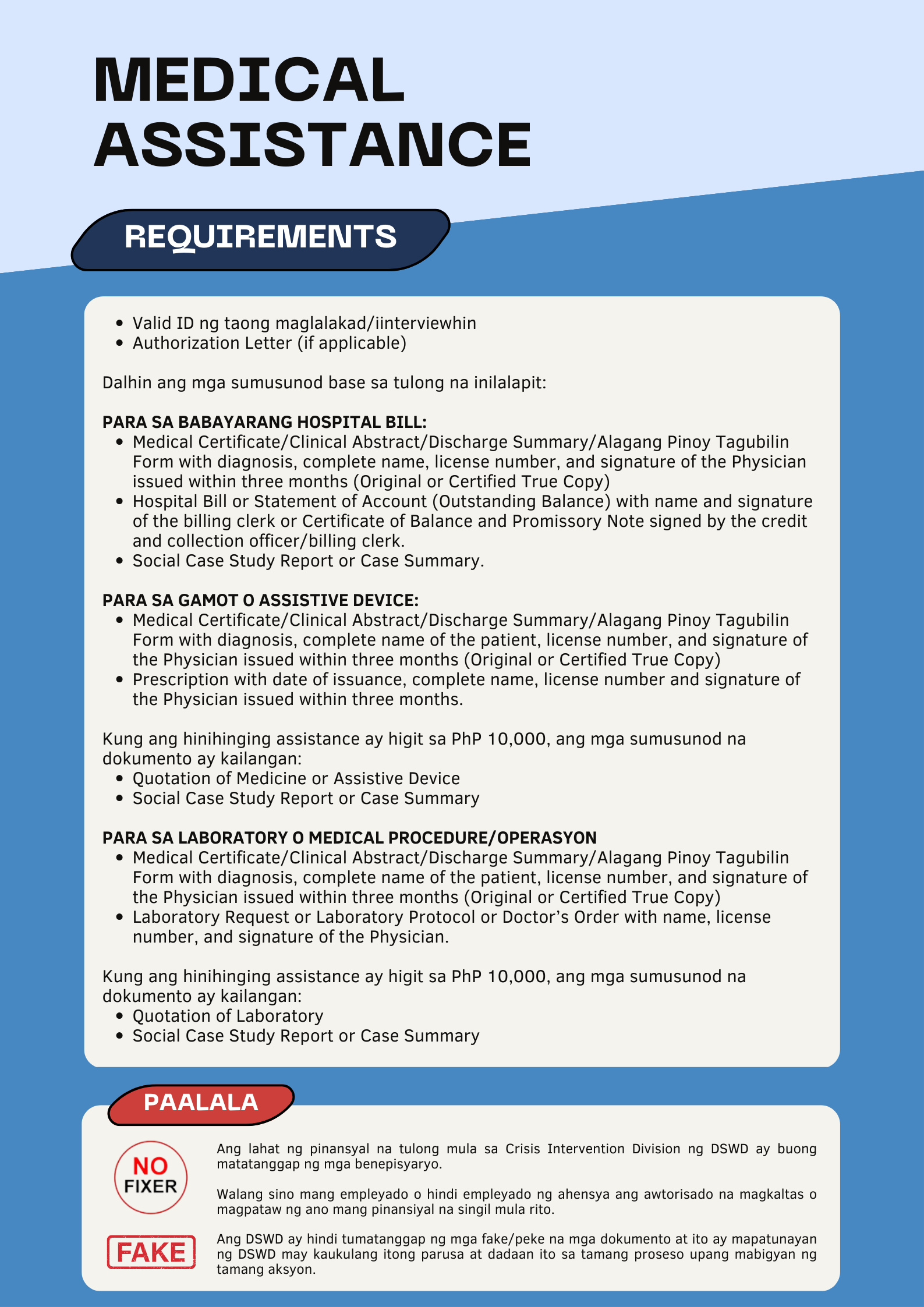
Proof of crisis situation (medical certificate, hospital bill, death certificate, police blotter, enrollment certificate, whichever is applicable)
Referral letter from LGU, hospital, barangay, or partner agency (if applicable)
Social Case Study Report, accomplished on-site at DSWD
Hospital bill or estimated cost of treatment (for medical cases: must be current, not older than 30 days)
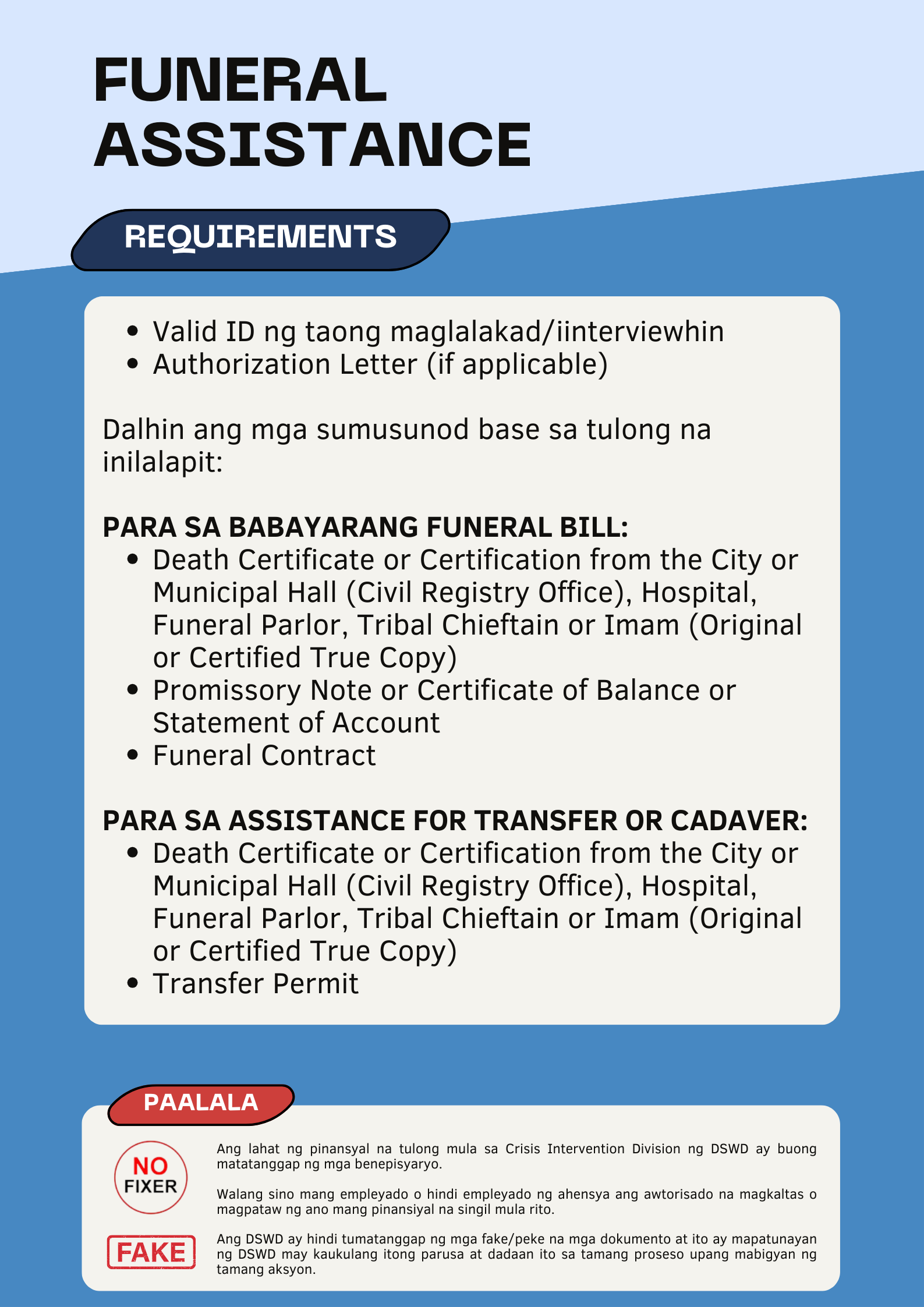
Death certificate (for burial assistance)
Enrollment or registration certificate (for educational assistance)
The social worker may ask for more.
8 steps
Step 1
Walk-in / Referral
Step 2
Intake & Document Verification
Step 3
Social Case Study & Assessment
Step 4
Supervisor Review & Validation
Step 5
Approval by Regional Director
Step 6
Finance Processing & Voucher Preparation
Step 7
Release of Assistance
Step 8
Recording, Monitoring & Reporting
Step details
Step 1
Walk-in / Referral
Beneficiary presents at DSWD Field Office or is referred by LGU, hospital, barangay captain, PNP, or partner agency. Walk-in applicants are received daily at the Social Welfare Office during regular office hours (Monday–Friday, 8:00 AM–5:00 PM). Emergency cases accepted 24/7 at the crisis center.
Step 2
Intake & Document Verification
Social Welfare Officer (SWO) conducts the intake process. Client fills out the Social Case Study Report (SCSR). All submitted documents are verified for authenticity and completeness. A deficiency slip is issued for incomplete submissions with a prescribed compliance period.
Step 3
Social Case Study & Assessment
The SWO prepares a comprehensive Social Case Study Report including household profile, income assessment, assets, and a detailed description of the crisis situation. The SWO recommends the type and amount of assistance based on DSWD guidelines and the severity of the crisis.
Step 4
Supervisor Review & Validation
The Division Supervisor or Unit Head reviews the SCSR and validates the social worker's recommendation. Compliance with DSWD Memorandum Circular standard amounts is checked. The supervisor may require additional documentation or conduct a verification call.
Step 5
Approval by Regional Director
The Regional Director or authorized signing official approves the assistance. For medical: up to PHP 20,000; burial: up to PHP 10,000; educational: up to PHP 5,000 per DSWD Memorandum Circular. Standard turnaround: 1–3 working days from SCSR submission.
Step 6
Finance Processing & Voucher Preparation
The Finance Division prepares the Disbursement Voucher (DV) or manager's check. The Obligation Request and Status (ORS) and Budget Utilization Request and Status (BURS) are obligated. COA pre-audit is conducted if required by the amount threshold.
Step 7
Release of Assistance
Client is notified via SMS or phone call. Client signs the voucher or payroll as acknowledgment of receipt: a legal requirement. Cash or manager's check issued at the Cashier's window. For hospitalized or bedridden patients, the check may be sent to the hospital or released to an authorized representative with SPA.
Step 8
Recording, Monitoring & Reporting
The case is recorded in the official AICS registry. A unique case number is assigned. Follow-up calls or visits may be scheduled for complex cases. Monthly statistical report submitted to DSWD Central Office for program monitoring and policy review.
Posts AICS payout-day, satellite-office opening, and CIU event albums.
Verify This Program Officially
Legal Basis
Memorandum Circular No. 16, s. 2022 (Revised Guidelines on AICS Implementation)
Official DSWD pages end in .dswd.gov.ph. Be cautious of pages or messages asking for payment to "release" a benefit, legitimate DSWD programs do not charge processing fees.
Ang AICS o Assistance to Individuals in Crisis Situation ay isa sa mga social welfare services ng DSWD na nagbibigay ng tulong medikal, pampalibing, transportasyon, edukasyon, pagkain, o tulong pinansyal para sa iba pang support services o pangangailangan ng isang tao o pamilya.
The AICS or Assistance to Individuals in Crisis Situation is one of the social welfare services of the DSWD that provides medical assistance, burial, transportation, education, food, or financial assistance for other support services or needs of a person or family.
Program’s Objective
Layunin ng AICS Program na tulungan ang mga mahihirap nating kababayan na sumasailalim sa krisis upang matugunan sa kanilang mga pangangailangan.
The objective of the AICS Program is to help our poor countrymen who are in crisis to meet their needs.
AICS Assistance
Medical Assistance
Funeral Assistance
Transportation Assistance
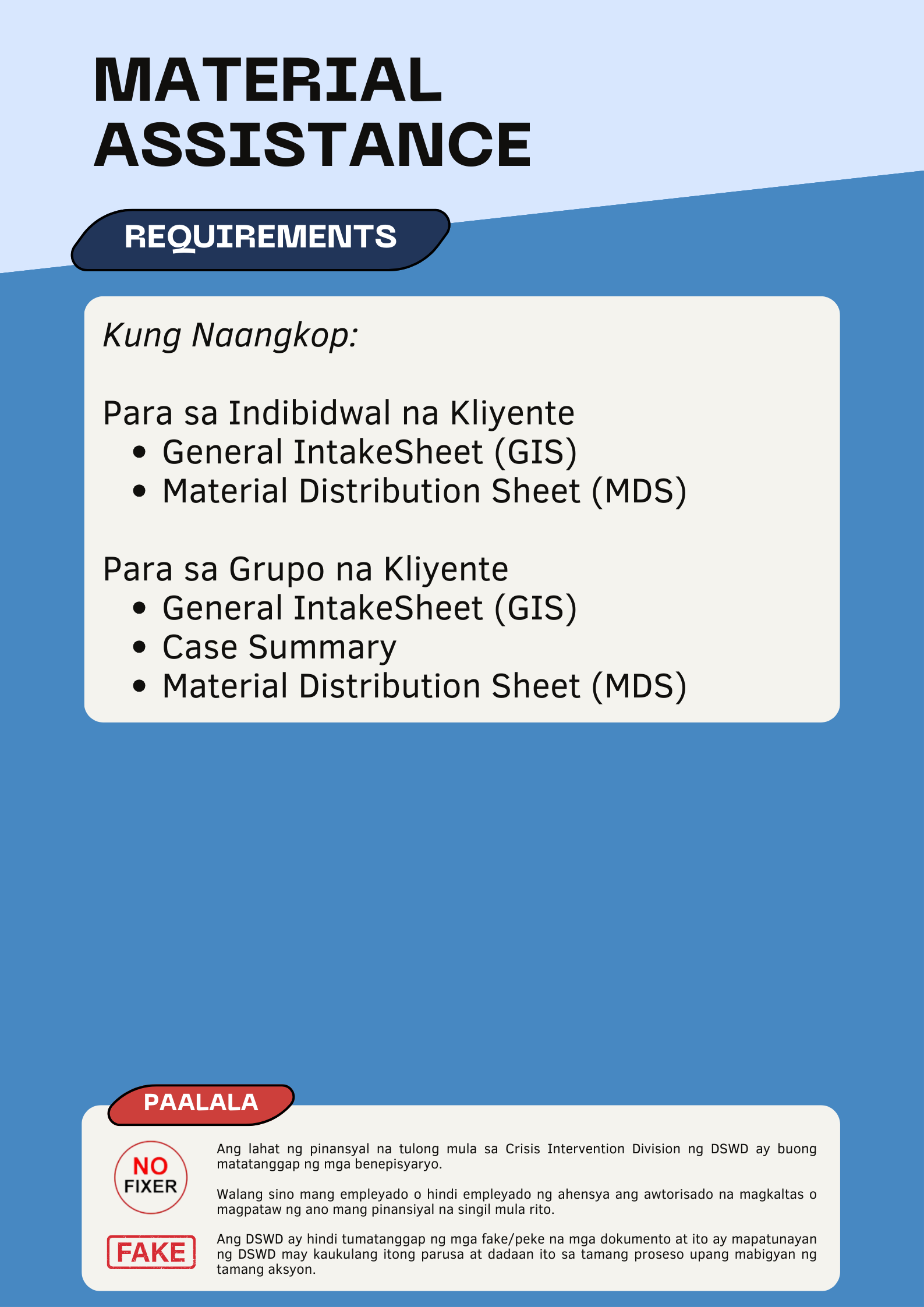
Material Assistance
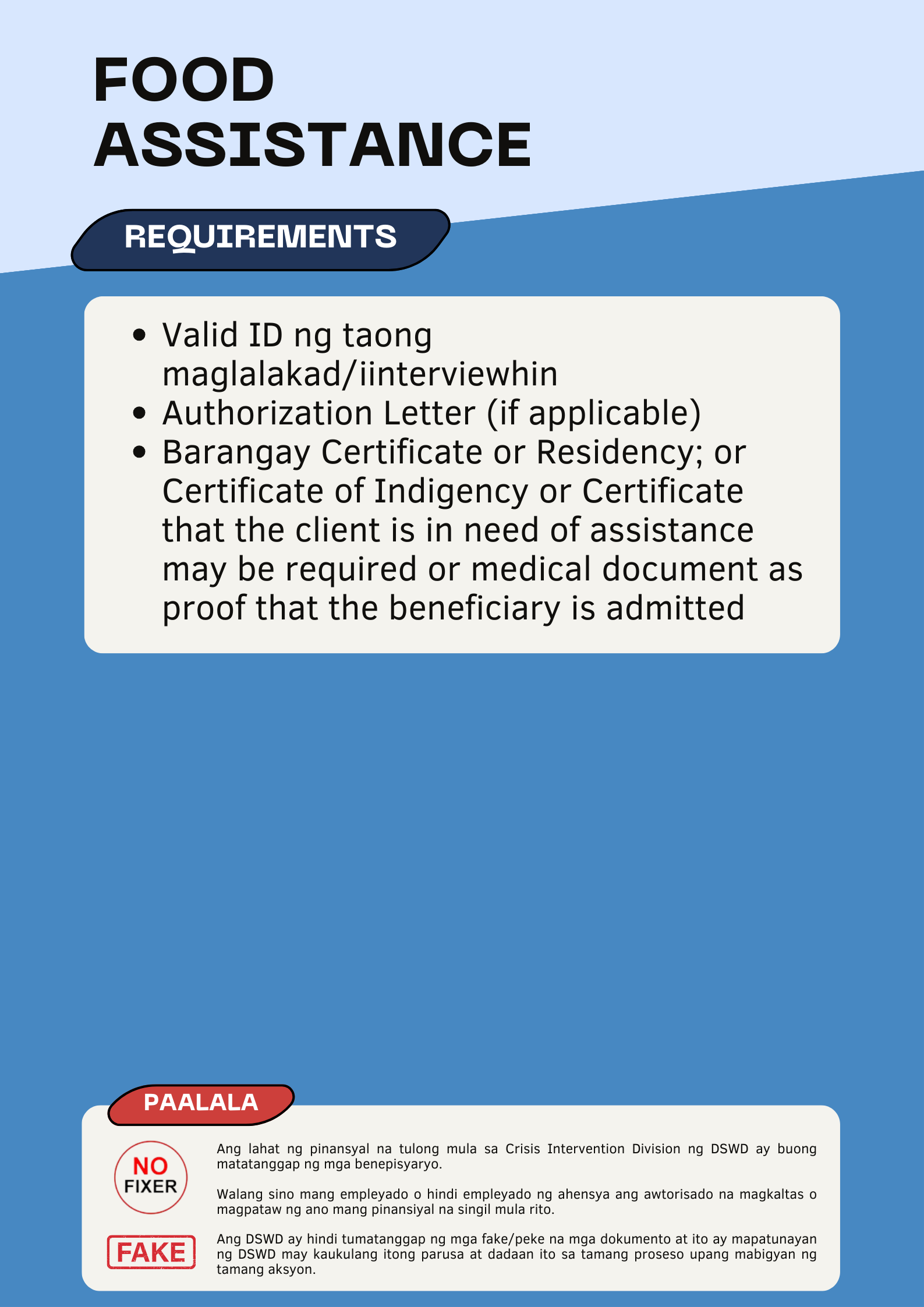
Food Assistance
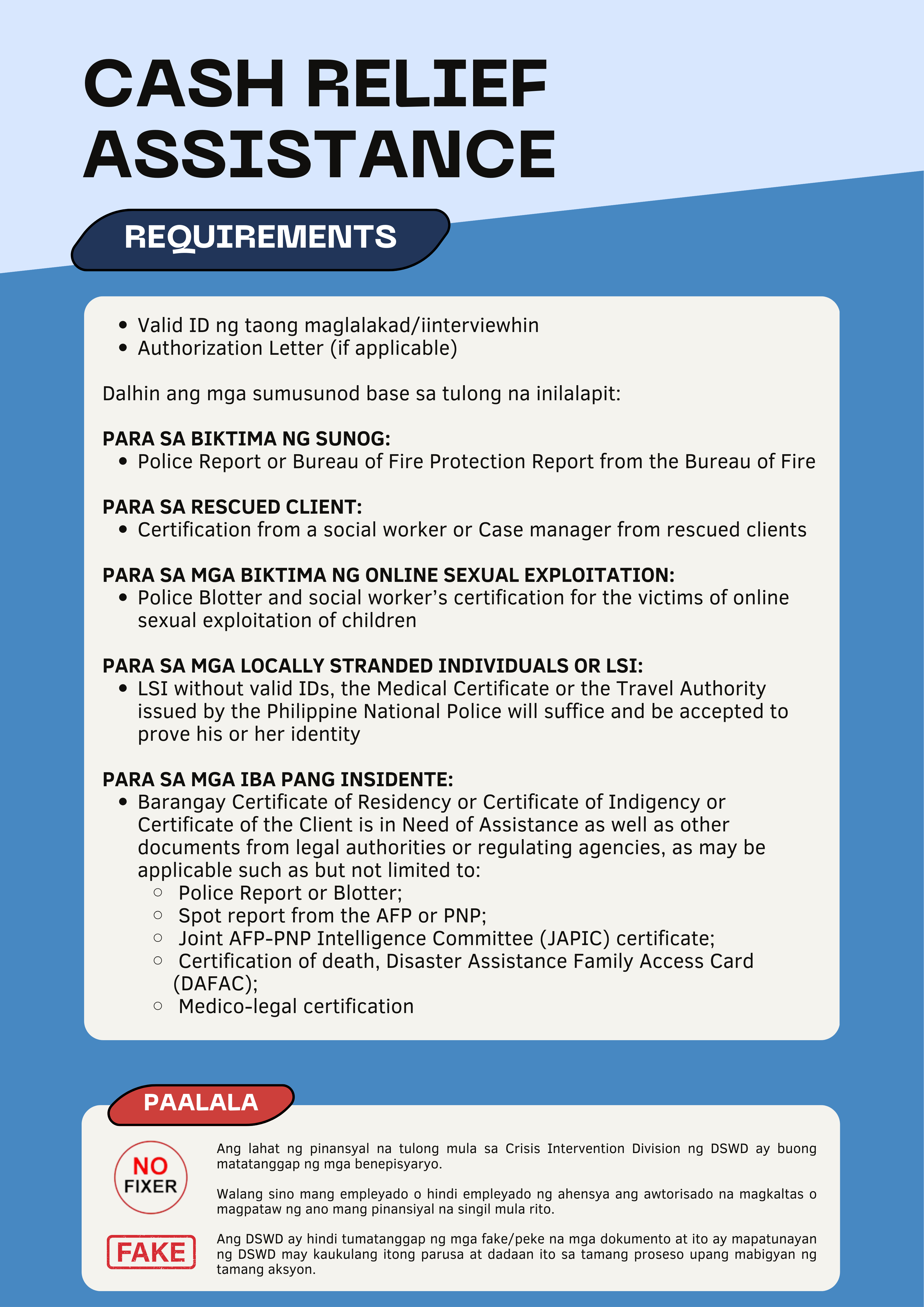
Cash Relief Assistance
Crisis Intervention
AKAP
Ayuda para sa Kapos ang Kita Program
One-time help for workers whose income falls short of the regional minimum wage
Who Qualifies: Workers whose earnings are below the regional minimum wage, including those with no income at the moment (for example contractual, seasonal, farm, fishing, construction and service workers) who face a medical, funeral, food or cash need. Workers who earn the full regional minimum wage or more are not covered.
Program Description
AKAP gives one-time assistance to workers and families whose income is below the regional minimum wage and who cannot meet a sudden need: a hospital bill, a funeral, food, or a cash shortfall. It is processed through the same crisis-intervention counters as AICS: DSWD Field Office III, its satellite offices and the municipal social welfare office. A social worker assesses every application, and the amount follows that assessment and the kind of help needed, within the ceiling of PHP 1,000 to PHP 10,000. Under the current guidelines, workers who earn the full regional minimum wage are no longer covered; AKAP is for those who earn less than it.
Coverage & Benefits
Type
Amount / Details
Kinds of Assistance
Medical, funeral, food, cash relief and rice subsidy
Amount
PHP 1,000 to PHP 10,000 per application, decided by the social worker's assessment
Frequency
One-time assistance; not a monthly or regular payment
Who Is Covered
Workers earning below the regional minimum wage, including those with no income
Where to Apply
DSWD Field Office III, satellite offices and the municipal social welfare office
Release
Cash or check, signed for on release
Important Note: AKAP is not a loan, and there is no fee to apply or to receive it. A message that asks you to pay, or to share your bank details, to "release" AKAP is a scam: apply only at DSWD offices or your municipal social welfare office.
Proof that your income is below the regional minimum wage: certificate of employment or payslip, Income Tax Return, or a certificate of no income
Barangay Certification of residence
Medical assistance: medical certificate or clinical abstract signed by the attending physician, and the hospital bill, prescription or quotation
Funeral assistance: PSA death certificate and the funeral receipt or contract
Food, cash relief and rice subsidy: the documents above are enough; the social worker may ask for more after the interview
The social worker may ask for more.
7 steps
Step 1
Apply at the Office
Step 2
Intake & Document Check
Step 3
Assessment
Step 4
Approval
Step 5
Finance Processing
Step 6
Release of Assistance
Step 7
Recording
Step details
Step 1
Apply at the Office
Go to DSWD Field Office III, a satellite office or your municipal social welfare office with your ID and proof of income, and say which kind of help you need: medical, funeral, food, cash relief or rice subsidy. Office hours are Monday to Friday, 8:00 AM to 5:00 PM.
Step 2
Intake & Document Check
A social worker records your application and checks your papers against the requirements for the kind of help you asked for. A deficiency slip lists anything that is missing and when to bring it.
Step 3
Assessment
The social worker interviews you, confirms that your income is below the regional minimum wage, and decides the amount within the ceiling, based on your need and the supporting papers.
Step 4
Approval
The assessment is reviewed and approved by the supervisor or the authorized approving officer. You are told if the application needs more papers or cannot be approved.
Step 5
Finance Processing
The Finance Division prepares the voucher and the payment for the approved amount.
Step 6
Release of Assistance
You are notified by SMS or phone call. Bring your valid ID and sign the voucher or payroll when you receive the assistance. If you cannot come in person, an authorized representative with a Special Power of Attorney may claim it.
Step 7
Recording
The release is recorded in the AKAP registry under your name, so that the office can see what you have already received.
Posts payout schedules and program announcements.
Verify This Program Officially
Legal Basis
Implemented by DSWD alongside the AICS crisis-intervention services (Memorandum Circular No. 16, s. 2022); the AKAP guidelines set who qualifies
Official DSWD pages end in .dswd.gov.ph. Be cautious of pages or messages asking for payment to "release" a benefit, legitimate DSWD programs do not charge processing fees.
SPISC
Social Pension for Indigent Senior Citizens
Monthly stipend for poor, frail senior citizens aged 60+
Note: Administering agency in transition: SPISC has historically been implemented by DSWD, but by law it is being transferred to the National Commission of Senior Citizens (NCSC). If DSWD FO3 can no longer process new SPISC nominations at the time you read this, contact NCSC directly at ncsc.gov.ph. Do not assume the program has ended.
Who Qualifies: Filipino senior citizens aged 60 years old and above who are indigent, have no regular income or pension (SSS, GSIS, or PVAO), are not 4Ps beneficiaries, and are nominated by their LGU-OSCA.
Program Description
SPISC provides a non-contributory monthly stipend to indigent senior citizens aged 60 and above who have no regular income or pension and are frail, sickly, or with disability. It is distinct from contributory pensions like SSS or GSIS. Under the Social Pension for Indigent Senior Citizens Act (lapsed into law July 2022), the stipend was increased from PHP 500 to PHP 1,000 per month. Nominations are coordinated through the LGU Office for Senior Citizens Affairs (OSCA).
Coverage & Benefits
Type
Amount / Details
Monthly Stipend
PHP 1,000 per month (increased from PHP 500)
Payment Schedule
Quarterly (PHP 3,000 per release)
Mode of Payment
Land Bank or on-site barangay payout
Age Requirement
60 years old and above
Program Scale (2024)
Roughly PHP 49.807 billion budgeted nationally for about 4 million beneficiaries
Important Note: Social Pension recipients who become 4Ps beneficiaries must be deactivated from SPISC, as the two programs may not be received simultaneously. If you receive a message claiming an "unclaimed" or "pending" pension and asking for a fee or personal banking details, it is a scam, SPISC never charges a processing fee.
Certification that applicant has no regular income or government pension (SSS/GSIS/PVAO Non-Membership or Non-Pension Certification)
Not a current 4Ps beneficiary
LGU-OSCA Nomination Letter signed by the Municipal/City OSCA Head
The social worker may ask for more.
7 steps
Step 1
Identification & Nomination
Step 2
Assessment & Validation
Step 3
Encoding in SPES Database
Step 4
Fund Allocation
Step 5
Preparation of Payroll
Step 6
Payout via LBP or On-Site
Step 7
Monitoring & Annual Updating
Step details
Step 1
Identification & Nomination
LGU Office for Senior Citizens Affairs (OSCA) identifies and nominates eligible senior citizens. Barangay officials assist in identifying indigent seniors. Nominees must meet all eligibility criteria: 60+, indigent, no pension, not 4Ps.
Step 2
Assessment & Validation
A social worker validates eligibility through interview and, if necessary, a home visit. Documents verified: Senior Citizen ID, birth certificate, and certificate of indigency from barangay.
Step 3
Encoding in SPES Database
Validated beneficiaries are encoded in the Social Pension Eligibility System (SPES) database. Regional masterlist prepared and submitted for final approval and fund allocation.
Step 4
Fund Allocation
Quarterly funds released via sub-allotment release order. Finance Division obligates funds and coordinates with LBP for payout processing.
Step 5
Preparation of Payroll
Municipal Links prepare the payout payroll list per barangay. Finance Unit processes the Disbursement Voucher, reviewed and approved by the accountant and Regional Director.
Step 6
Payout via LBP or On-Site
Quarterly payout conducted through Land Bank branches or on-site barangay-level distribution. Beneficiaries present Senior Citizen ID and sign payroll to receive PHP 3,000 per quarter.
Step 7
Monitoring & Annual Updating
Annual re-validation of all beneficiaries. Deceased, transferred, or no longer eligible beneficiaries removed from the database. New slots filled from the municipal waitlist.
Check for OSCA payout schedules and program updates; confirm current administering agency before relying on posted schedules.
Verify This Program Officially
Legal Basis
Republic Act No. 11350 (NCSC Act) and the Social Pension for Indigent Senior Citizens Act (lapsed into law July 2022)
Official DSWD pages end in .dswd.gov.ph. Be cautious of pages or messages asking for payment to "release" a benefit, legitimate DSWD programs do not charge processing fees.
I. Program Overview
Republic Act No. 9994 or the “Expanded Senior Citizens Act of 2010” institutionalizes social protection to senior citizens by providing additional government assistance through Social Pension for Indigent Senior Citizens (SPISC). In this program, indigent senior citizens are entitled to a monthly stipend amounting to Five Hundred Pesos (PhP500.00) which aims to augment the daily subsistence and other medical needs of the beneficiaries.
The Department of Social Welfare and Development (DSWD), as the lead agency in social welfare and development, implements the SPISC in the country since year 2011 through the DSWD Field Offices (FOs) using the most cost-effective and efficient mode of payment to deliver the stipend to the beneficiaries.
General Objective
To improve the living condition of eligible indigent senior citizens.
Specific Objectives
To augment capacity of indigent senior citizens to meet their daily subsistence and medical requirements;
To reduce incidence of hunger among indigent senior citizens; and
To protect indigent senior citizens from neglect, abuse, or deprivation.
Legal Bases: National Laws
Section 11, Article XIII, 1987 Philippine Constitution. “The State shall adopt an integrated and comprehensive approach to health development which shall endeavour to make essential goods, health and other social services available to all people at affordable cost. There shall be priority for the needs of the underprivileged, sick, elderly, disabled, women and children. The State shall endeavour to provide free medical care to paupers.”
Section 4, Article XV, 1987 Philippine Constitution. “The family has the duty to care for its elderly members but the State may also do so through just programs of social security.”
Section 1, Article 20, Rule V, Implementing Rules and Regulations of Republic Act 9994. Pursuant to the eligibility criteria as may be determined by the DSWD, indigent senior citizens shall be entitled to a monthly stipend amounting to Five Hundred Pesos (Php500.00) to augment the daily subsistence and other medical needs of senior citizens. The grant of social pension shall be subject to a review every two (2) years by Congress, in consultation with the DSWD within three (3) months after convening the Congress.
Philippine Plan of Action for Senior Citizens 2012–2016. Promotion of active ageing through social protection and support for the rights and welfare of senior citizens and their empowerment.
DSWD Issuances / Guidelines
Memorandum Circular No. 04, series of 2019: “Omnibus Guidelines in the Implementation of the Social Pension for Indigent Senior Citizens.” This provides unified direction to DSWD FOs in partnership with the Local Government Units (LGUs) to ensure an effective and efficient implementation of the program.
II. Modalities
The DSWD FO will inform the City/Municipality through the Office of the Senior Citizen Affairs (OSCA) Head and Local Social Welfare and Development Officer (LSWDO) of the schedule of the pay-out.
The release of monthly stipend at PhP500.00 per beneficiary will be done every six (6) months, or PhP3,000.00 per semester.
Update: Republic Act 11916 raised the social pension to PhP1,000.00 a month, in effect from January 2024. DSWD releases it monthly where feasible, otherwise every two or three months; AyudaGO runs the payout quarterly (PhP3,000.00).
III. Target Beneficiaries
From 2011 to 2014, only those 77 years old and above were included in the program, but in 2015 the age requirement expanded by covering those who are 65 years and older. In 2016, indigent senior citizens 60 years old and above became able to avail of the program.
Senior citizens who are not included in the master-list of the Social Pension Program shall be referred to the concerned OSCA or DSWD FO through the Social Pension Program Management Office (SPPMO) for assessment.
IV. Eligibility Criteria
Sixty (60) years old and above senior citizens who are:
Frail, sickly or with disability;
Receiving no pension from Government and Private Institutions;
Without a permanent source of income; and
Without regular support from family or relatives for his/her basic needs.
V. Documentary Requirements
In case the stipend will be claimed by an authorized representative, he/she shall present the following:
Accomplished Certification and Authorization
Photocopy of OSCA ID of the Beneficiary
Photocopy of ID of the Claimant
Certificate of Existence
For deceased beneficiaries the claimant shall present the following:
Original or Certified True Copy of Death Certificate
Accomplished Warranty and Release from Liability
Photocopy of OSCA ID of the Beneficiary
Photocopy of ID of the Claimant
In case the beneficiary died on any day within the semester, he/she shall still be entitled to receive the full amount of stipend for the semester, to be given to the authorized representative.
Conditional cash grants improving health, nutrition, and education
Who Qualifies: Poor households identified through the Listahanan (National Household Targeting System) using the Proxy Means Test, including farmers, fisherfolk, indigenous peoples, homeless families, and informal settlers automatically considered under DSWD targeting; households must have children aged 0–18 or a pregnant woman.
Program Description
4Ps is the government's flagship conditional cash transfer program, institutionalized under Republic Act No. 11310 (2019), providing dual cash grants to poor households: a Health Grant supporting health and nutrition (especially for children 0–5 and pregnant/lactating mothers), and an Education Grant improving school attendance and retention for children aged 6–18. It is implemented in coordination with DOH, DepEd, DILG, the National Nutrition Council, NAPC, and Land Bank of the Philippines. Regular 4Ps household participation is capped at 7 years; a Modified CCT (MCCT) track extends coverage to street families, indigenous peoples in geographically isolated areas, and families in need of special protection. Compliance with conditionalities is monitored regularly, and household eligibility is revalidated at least once every 3 years.
Coverage & Benefits
Type
Amount / Details
Health Grant
Per household: supports health & nutrition for children 0–5 and pregnant/lactating mothers
Education Grant (Elementary)
Commonly cited at PHP 300/child/month. Verify current rate
Education Grant (Junior High)
Commonly cited at PHP 500/child/month. Verify current rate
Education Grant (Senior High)
Commonly cited at PHP 700/child/month. Verify current rate
Rice Subsidy
Supplementary, per DSWD MC No. 6, s. 2017
Payment Mode
Landbank Visa Cash Card (quarterly)
Program Duration
Up to 7 years per household (regular track); MCCT track for special cases
Important Note: 4Ps grantees who fail three consecutive quarters of conditionality compliance may be suspended. Family Development Sessions (FDS) are mandatory monthly meetings for all grantees.
Household must be included in the Listahanan (NHTS) database and classified as poor
Must have children aged 0–18 years old or a pregnant woman in the household
Grantee must be the mother or female head of household
PSA Birth Certificates of all children 0–18
Marriage Certificate (or PSA Negative if unmarried)
Barangay Certification of residence
Enrollment in nearest health center (for health conditionality compliance)
School enrollment confirmation from DepEd (for education conditionality)
The social worker may ask for more.
8 steps
Step 1
Targeting via Listahanan/NHTS
Step 2
Household Registration
Step 3
Conditionality Agreement
Step 4
Compliance Verification (Quarterly)
Step 5
Fund Download & Processing
Step 6
Cash Grant Release
Step 7
Grievance & Appeals
Step 8
Annual Updating & Graduation
Step details
Step 1
Targeting via Listahanan/NHTS
Poor households identified through the National Household Targeting System. A Proxy Means Test (PMT) is applied to compute each household's poverty score. Households below the regional poverty threshold qualify for 4Ps.
Step 2
Household Registration
Eligible households invited to register at the Municipal Link office. Household profile form completed. Grantee (mother or female head) enrolled and photographed. Household data encoded in the 4Ps Management Information System.
Step 3
Conditionality Agreement
Grantees sign a Participation Agreement committing to conditionalities: children 0–5 attend monthly health check-ups and growth monitoring; children 6–18 maintain 85% school attendance; pregnant women attend pre-natal check-ups; participation in Family Development Sessions (FDS).
Step 4
Compliance Verification (Quarterly)
Every quarter, Municipal Links coordinate with local health centers and public schools to verify compliance. Non-compliance results in deductions: 1st violation = warning; 2nd = suspension of one grant; 3rd = suspension of both grants.
Step 5
Fund Download & Processing
DSWD Central Office releases quarterly grants to Land Bank. FO3 receives sub-allotment. LBP processes cash card credit for all compliant grantees. Non-compliant households' grants are withheld proportionally.
Step 6
Cash Grant Release
Compliant grantees' grants credited to their Landbank Visa Cash Card quarterly. Grantees withdraw at LBP ATMs, Landbank branches, or accredited retail partners. SMS notification sent upon crediting.
Step 7
Grievance & Appeals
Grievance Redress System (GRS) handles complaints on targeting errors, non-receipt, or compliance deductions. Municipal Links resolve local complaints; unresolved cases escalated to DSWD FO3. Resolution within 30 working days.
Step 8
Annual Updating & Graduation
Beneficiary household data updated annually. Households exit the program ("graduate") when the youngest child turns 18. Supply-side support to health facilities and schools monitored alongside cash grants to ensure availability of services.
Posts Family Development Session photos, payout schedules, and graduation ceremonies.
Verify This Program Officially
Legal Basis
Republic Act No. 11310 (2019), the "Pantawid Pamilyang Pilipino Program Act"
Official DSWD pages end in .dswd.gov.ph. Be cautious of pages or messages asking for payment to "release" a benefit, legitimate DSWD programs do not charge processing fees.
Republic Act No. 11310: Pantawid Pamilyang Pilipino Program Act
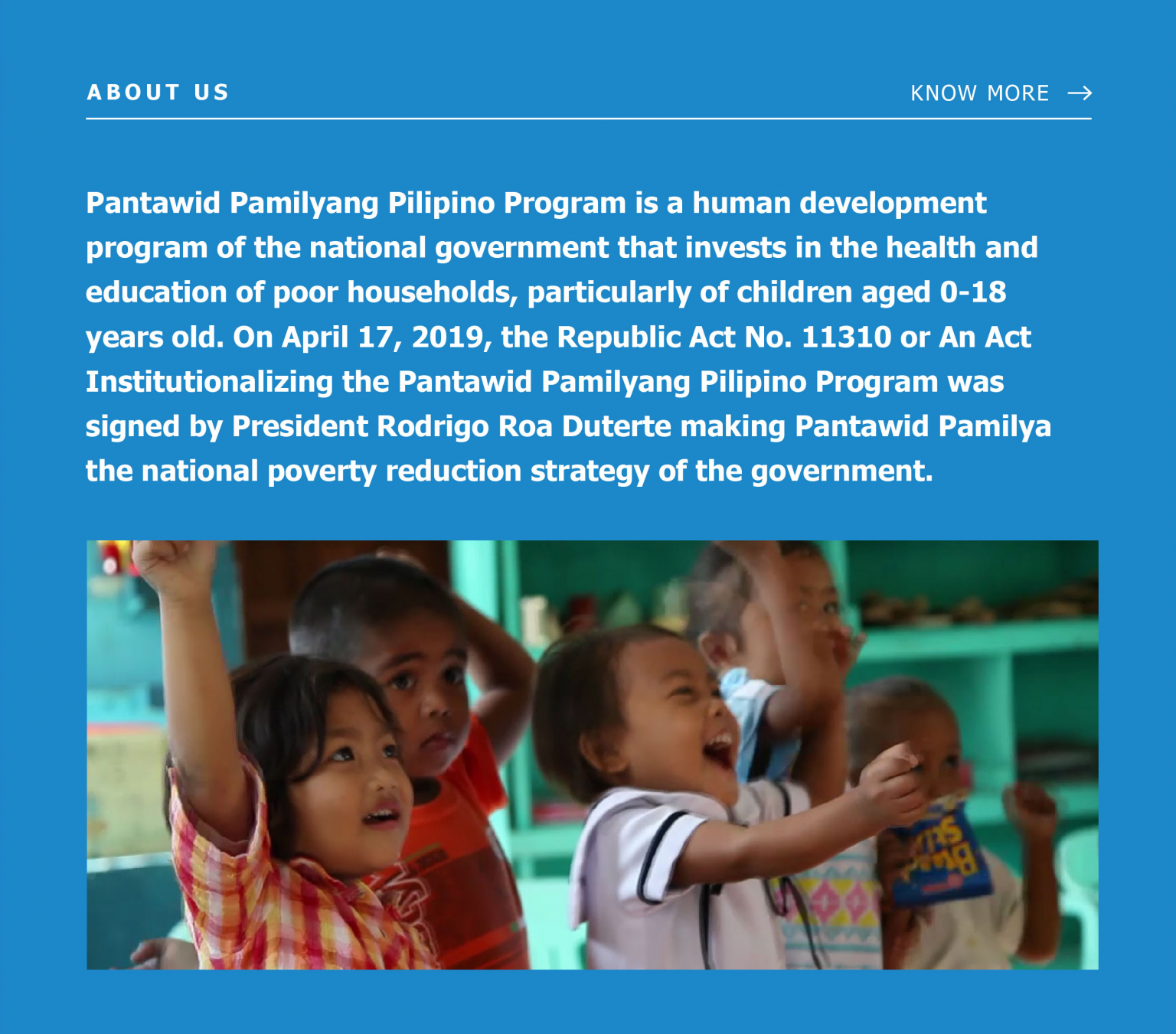
The Pantawid Pamilyang Pilipino Program (4Ps), implemented by the Department of Social Welfare and Development (DSWD), is the national poverty reduction strategy of the government as stated under Republic Act No. 11310 or “An Act institutionalizing Pantawid Pamilyang Pilipino Program (4Ps)” which was signed on April 17, 2019.
Patterned after the conditional cash transfer scheme implemented in other developing countries, 4Ps provides cash grants to beneficiaries provided that they comply with the set of conditions required by the program.
Eligible Beneficiaries
To be eligible for cash grants, poor and near-poor families must be willing to comply with the conditions and meet any of the following criteria:
Has a household member aged 0–18 years old.
Has a household member who is pregnant at the time of enumeration.
Farmers, fisherfolks, homeless families, indigenous peoples, informal settlers and those in geographically isolated and disadvantaged areas are automatically included in the standard targeting system in the DSWD but will still have to meet the criteria to be eligible for cash grants.
RA 11310 Explained
Whole-of-Government Approach
Within the framework of a national poverty alleviation strategy and a holistic social protection program, the various agencies of government implementing multi-stakeholder programs and services for the poor shall guarantee that the same complement and converge seamlessly with the aim of ensuring that the targeted household-beneficiaries are alleviated from poverty and remain non-poor even after the prescribed maximum period for the conditional cash grant.
Delivered together with the 4Ps Advisory Council member agencies.
SLP
Sustainable Livelihood Program
Livelihood funds, training and job support for poor and vulnerable families
Who Qualifies: Poor and vulnerable families: households identified as poor in the Listahanan, 4Ps households and graduates, and others recommended by the LGU or barangay, who are able to take part in a livelihood or a job. Microenterprise Development participants must be at least 16 years old (with the consent of a parent or guardian if under 18); Employment Facilitation participants must be 18 or older. No more than two members of the same household may take part.
Program Description
SLP is DSWD's capability-building program for poor and vulnerable families, working through two tracks. Under Microenterprise Development, participants form an SLP Association (SLPA) and run a small enterprise supported by a Seed Capital Fund, a Skills Training Fund, or Cash for Building Livelihood Assets. Under Employment Facilitation, an individual is helped into a job with the Employment Assistance Fund and referrals to employers and training partners. SLP is carried out with LGUs and partners such as TESDA, DTI and DOLE.
Coverage & Benefits
Type
Amount / Details
Seed Capital Fund (Microenterprise Development)
Up to PHP 15,000 per participant, given to the SLP Association for its enterprise
Skills Training Fund (Microenterprise Development)
Up to PHP 15,000 per participant for skills training
Cash for Building Livelihood Assets
Paid work on community livelihood assets at 100% of the regional minimum wage, up to 11 days
Employment Assistance Fund (Employment Facilitation)
Up to PHP 5,000 per participant for pre-employment needs, with job referral
Training Partners
TESDA, DTI, DOLE, LGUs and private-sector partners
Age and Household
Microenterprise Development 16+ (parental consent under 18); Employment Facilitation 18+; at most two members per household
Important Note: The Seed Capital Fund is a grant, not a loan, but it must be used only for the approved livelihood project. Nobody may charge you a fee to join SLP or to "release" a fund.
Valid government-issued ID; for a minor aged 16 to 17, the PSA birth certificate and the written consent of a parent or guardian
Barangay Certification of residence and Barangay Certificate of Indigency
Proof that the household is poor or vulnerable (Listahanan or 4Ps record, or the LGU's recommendation)
Attendance at the community orientation and the capability-building sessions
Seed Capital Fund: membership in an SLP Association, the association's registration or accreditation, and a project proposal or business plan prepared with the SLP project development officer
Skills Training Fund: enrolment in, or a certificate from, the training provider
Employment Assistance Fund: a job offer or certificate of employment, and the pre-employment papers (NBI or police clearance, medical certificate)
The social worker may ask for more.
8 steps
Step 1
Orientation & Profiling
Step 2
Choosing the Track
Step 3
Forming the SLP Association
Step 4
Training & Capability Building
Step 5
Proposal & Approval
Step 6
Release of the Fund
Step 7
Employment Facilitation
Step 8
Monitoring & Technical Assistance
Step details
Step 1
Orientation & Profiling
Interested families attend the community orientation held with the LGU and the barangay. The SLP project development officer records each person's household profile, interests and skills, and checks that no more than two members of one household are enrolled.
Step 2
Choosing the Track
Each participant chooses, with the officer, between Microenterprise Development (a small enterprise run with an SLP Association) and Employment Facilitation (getting a job). The minimum age is 16 for Microenterprise Development and 18 for Employment Facilitation.
Step 3
Forming the SLP Association
Microenterprise participants with a common enterprise form an SLP Association with its officers, open an association bank account, and have the association registered or accredited. Members under 18 need the written consent of a parent or guardian.
Step 4
Training & Capability Building
Participants attend training in running an enterprise, bookkeeping, marketing and technical skills, or job-readiness sessions for Employment Facilitation, with TESDA, DTI, DOLE and LGU partners. The Skills Training Fund can cover the cost of training.
Step 5
Proposal & Approval
The association prepares its project proposal with the officer. DSWD reviews the proposal and approves the grant, which can never go above the ceiling for that kind of fund. The person who proposes a grant is never the one who approves it.
Step 6
Release of the Fund
Finance releases the approved grant. The Seed Capital Fund goes to the association's bank account for its members; Skills Training and Employment Assistance go to the individual participant. Members sign the acknowledgment of what they receive.
Step 7
Employment Facilitation
Employment Facilitation participants are referred to job fairs, PESO and partner employers. The Employment Assistance Fund pays for the papers and transport needed to start work.
Step 8
Monitoring & Technical Assistance
The project development officer visits regularly, coaches the enterprise and checks that the funds are used for the approved project. A participant or association graduates when the enterprise runs steadily on its own or the participant is employed.
SLP Program Photo
Official DSWD FO3 documentation photo
Live search of the official DSWD FO3 YouTube channel
Short-term paid work for low-income students, fresh graduates and persons with disabilities
Who Qualifies: College undergraduates and recent graduates from low-income families, and persons with disabilities (PWDs) who are listed in the Listahanan or certified as low-income by the Municipal Social Welfare and Development Office. Workers are engaged through a partner LGU (in their own municipality) or a partner State University or College.
Program Description
DSWD runs the KALAHI-CIDSS Cash-for-Work Program to give short-term jobs and cash pay to low-income students, fresh graduates and vulnerable groups. It offers temporary paid work so that people can meet their basic needs while gaining work experience. Participants do clerical work, data encoding and community profiling, or support local government and agency projects. Cash-for-Work is carried out through partner local government units (LGUs) and State Universities and Colleges (SUCs). It is one of the modalities of KALAHI-CIDSS (Kapit-Bisig Laban sa Kahirapan - Comprehensive and Integrated Delivery of Social Services); the community-driven development side, where barangays plan and manage their own sub-projects, is described under In Detail.
Coverage & Benefits
Type
Amount / Details
Target Groups
College undergraduates, recent graduates from low-income families, and persons with disabilities
Students
Part-time, usually 4 hours a day, for a set number of days
Graduates
Full-time, 8 hours a day, for projects lasting 10 to 90 days
Persons with Disabilities
Usually 10 days of service. If a PWD is physically unable to do the tasks, an immediate family member or caregiver may render the work on the PWD's behalf
Pay
PHP 550 for each day worked (the regional minimum wage; a half-day counts as half), unless the partner pays its own stipend
Tasks
Clerical work, data encoding, community profiling, and support to local government and agency projects
Partners
Local government units (LGUs) and State Universities and Colleges (SUCs)
Important Note: Cash-for-Work is a short-term engagement, not a regular job. Pay is for days actually worked, and there is no fee to apply: slots are announced by the partner LGU or State University or College.
Students: school ID or certificate of enrolment for the current term
Graduates: diploma or transcript of records (graduated within the last two years)
Persons with disabilities: PWD ID issued by the city or municipal PDAO
Barangay Certificate of Indigency, as proof of low income
Barangay Certification of residence
Daily attendance record, kept by the partner and signed by its supervisor; it is the basis of your pay
The social worker may ask for more.
8 steps
Step 1
Partnership
Step 2
Call for Applicants
Step 3
Screening & Validation
Step 4
Orientation & Deployment
Step 5
Daily Attendance
Step 6
Payroll
Step 7
Payment
Step 8
Completion
Step details
Step 1
Partnership
An LGU or a State University or College signs an agreement with DSWD Field Office III that states the project, the tasks, the number of slots for students, graduates and persons with disabilities, and the dates.
Step 2
Call for Applicants
The partner announces its slots. Students, graduates and PWDs apply at the municipal social welfare office of the partner LGU, or with the focal person of the partner State University or College.
Step 3
Screening & Validation
For an LGU partner, the municipal social worker checks your documents and that you come from a low-income family. For a State University or College partner, DSWD Field Office III does this with the school's focal person. Students, graduates and PWDs each have their own documents.
Step 4
Orientation & Deployment
Selected workers receive an orientation and an assignment: clerical work, data encoding, community profiling, or support to a local government or agency project. Students are scheduled for part of the day; graduates work full days for 10 to 90 days.
Step 5
Daily Attendance
The partner supervisor records attendance on every working day (present, half-day or absent). Pay is for the days actually worked.
Step 6
Payroll
At the end of each pay period the payroll is prepared from the attendance sheet: days worked multiplied by the daily rate. It is checked and sent to the Finance Division.
Step 7
Payment
The Finance Division pays the approved payroll. Each worker signs the payroll as acknowledgment of receipt.
Step 8
Completion
When the engagement ends, the partner reports the work done and each worker receives a certificate of work accomplishment. The slot may then go to another applicant.
A well-established, actively-maintained official page documenting sub-project openings, community assemblies, and turnover ceremonies.
Verify This Program Officially
Legal Basis
Implemented under DSWD's community-driven development mandate; scaled up as KC-NCDDP following NEDA Board approval, January 2013
Official DSWD pages end in .dswd.gov.ph. Be cautious of pages or messages asking for payment to "release" a benefit, legitimate DSWD programs do not charge processing fees.
Kapit-Bisig Laban sa Kahirapan – Comprehensive and Integrated Delivery of Social Services
About the Program
The Kapit-Bisig Laban sa Kahirapan–Comprehensive and Integrated Delivery of Social Services (KALAHI-CIDSS) is one of the government’s major programs to help reduce poverty in the Philippines. It is led by the Department of Social Welfare and Development (DSWD) and focuses on giving people the power to decide and take part in improving their own communities.
Launched in 2003, the program follows the Community-Driven Development (CDD) approach to working where people in the barangay (village) themselves identify their most urgent needs, plan the solutions, and even help implement the projects. This approach recognizes that local people know best what their community truly needs. Through KALAHI-CIDSS, communities in poor municipalities are given the resources, training, and voice to take part in development. The program allows them to choose projects to build (such as roads, water systems, schools, or health centers) and to decide how funds should be used. It also strengthens the partnership between the local government and the people, helping them work together for a common goal.
The main goal of KALAHI-CIDSS is to make communities more empowered, united, and capable of improving their access to basic services while promoting transparent and inclusive governance.
Over the years, the program has made a lasting impact in many communities. It has improved access to basic services like clean water, education, and health care. It has also encouraged empowerment and inclusion, giving people, especially women and marginalized groups, a voice in decision-making. More importantly, it has built a sense of ownership and accountability, where people take pride in the projects they helped create and maintain.
In essence, KALAHI-CIDSS shows that when communities come together, guided and trusted by the government, real and lasting change begins from the ground up.
Community-Driven Development (CDD): Empowering People, Strengthening Communities
Community-Driven Development (CDD) is a strategy that places communities at the center of decision-making and development. It is built on a simple yet powerful principle: when people are given the opportunity to participate, access resources, and take ownership, they become active drivers of sustainable change.
At its core, CDD provides control over decisions. It fosters a strong sense of ownership by empowering individuals and communities to make choices that reflect their needs, values, and priorities. This participatory approach ensures that development initiatives are relevant, inclusive, and responsive to local realities.
CDD also ensures control over resources. By giving communities access to financial, technical, and organizational support, individuals are better equipped to become self-sufficient and achieve their goals. This access not only strengthens capacity but also builds confidence and accountability at the grassroots level.
Together, these elements result in genuine community-driven development, where programs integrate local empowerment, participatory governance, and demand-responsiveness. CDD promotes administrative autonomy, strengthens accountability between stakeholders, and enhances local capacity to plan, implement, and sustain projects.
Through this approach, communities are not just beneficiaries of development. They are partners and leaders in creating meaningful, lasting progress.
KALAHI-CIDSS Modalities: Expanding Community-Driven Development
The KALAHI-CIDSS of the Department of Social Welfare and Development adopts various modalities to respond to the diverse needs of communities. Anchored in the Community-Driven Development (CDD) approach, these modalities ensure that assistance is inclusive, responsive, and adaptable across different contexts.
Kapangyarihan at Kaunlaran sa Barangay (KKB)
The KKB modality is the core implementation of KALAHI-CIDSS. It empowers communities to identify their priority needs, plan and implement sub-projects, and manage resources. Through participatory processes, communities take the lead in building essential infrastructure such as roads, water systems, schools, and health facilities. KKB strengthens local governance, promotes transparency, and builds a strong sense of ownership among community members.
Cash for Work (CFW)
The Cash-for-Work modality provides short-term employment to individuals, particularly those affected by poverty, disasters, or economic disruptions. Participants are engaged in community projects such as infrastructure development, environmental management, and rehabilitation activities. Beyond immediate financial assistance, CFW helps stimulate local economies while contributing to community improvement.
Cash-for-Work for Higher Education Institutions (CFW-HEI)
The KALAHI-CIDSS Cash-for-Work (CFW) partnership with Higher Education Institutions (HEIs) is a strategic expansion designed to support graduating students and recent graduates, including those with disabilities, as they transition from academia to the workforce. It bridges the gap between financial need and professional readiness, utilizing the university environment as the primary site for community service and administrative training. Additionally, it targets “vulnerable” students, primarily those from low-income households, to prevent them from dropping out or to provide a financial cushion immediately following graduation.
The tasks include Administrative Assistance, Information Campaigns, Research & Surveys, and Campus Maintenance. Specifically, this could be encoding student records, organizing library archives, assisting in registrar/dean offices, assisting the school’s Social Marketing Unit (SMU) or Public Affairs office in creating content or distributing information, helping with community profiling or data entry for university-led outreach programs, and assisting in “Green Campus” initiatives like communal gardening or waste management monitoring.
Cash-for-Work for Persons with Disabilities (CFW-PWD)
The KALAHI-CIDSS Cash-for-Work (CFW) for Persons with Disabilities (PWDs) is a social protection initiative that provides temporary income in exchange for community service. It aims to provide immediate financial relief to low-income PWDs while encouraging community participation. It shifts the perspective from PWDs being mere “recipients” of aid to active “contributors” to community development. It prioritizes those listed in Listahanan or those certified as “low-income” by the Municipal Social Welfare and Development Office.
This is usually 10 days of rendered service. The tasks include light labor, such as community cleaning, vegetable gardening, or tree planting. It also includes clerical, technical or social tasks, such as assisting in the Barangay or Persons with Disability Affairs Office (filing, encoding, or organizing documents), and assisting in community data gathering or advocacy sessions. In cases where a PWD is physically unable to perform the tasks, an immediate family member or caregiver can render the work on their behalf so the family still receives the income.
Panahon ng Pagkilos: Philippine Community Resilience Project
The Pagkilos modality is the newest initiative of KALAHI-CIDSS that strengthens infrastructure resilience to withstand climate change impacts and safeguards livelihoods through social protection measures and responsive regulations. It empowers local governments and communities to take adaptive action by enhancing their understanding and equipping them with climate data, resources, and practical tools for decision-making.
It also mainstreams integrated adaptation governance through coordinated collaboration among stakeholders, ensuring aligned and effective responses to climate-related challenges. Where applicable, Pagkilos promotes and scales up nature-based solutions as part of building sustainable and resilient communities.
Together, these modalities demonstrate the flexibility and strength of KALAHI-CIDSS in addressing varying community needs: empowering people, improving livelihoods, and fostering inclusive and sustainable development.
Disaster Response Programs
1 program
DRRM
Disaster Response / Relief Operations
Pre-positioned relief, cash assistance, and community recovery
Who Qualifies: Families affected by natural disasters, calamities (typhoons, earthquakes, flooding, etc.), or public emergencies declared by the NDRRMC or LGU within Region 3.
Program Description
Disaster response is a core DSWD mandate under Republic Act No. 10121 (Philippine Disaster Risk Reduction and Management Act of 2010), which designates DSWD as Vice-Chairperson for Disaster Response of the National Disaster Risk Reduction and Management Council (NDRRMC). At the national level this is coordinated by DSWD's Disaster Response Management Bureau (DRMB) across three clusters: Food and Non-Food Items (FNI), Camp Coordination and Camp Management (CCCM), and Protection (IDPP). DSWD FO3 implements the full spectrum of response locally: pre-positioning of Family Food Packs (FFPs) and non-food items (NFIs), rapid needs assessment (PDNA), emergency relief distribution, cash assistance, and recovery programs. The DROMIC center is activated upon any disaster declaration to provide real-time coordination and information management, supported by Quick Response Teams (QRTs) for on-the-ground deployment.
Coverage & Benefits
Type
Amount / Details
Cash Assistance
PHP 5,000 per family (standard)
Family Food Pack
Pre-positioned at Regional Warehouse
Non-Food Items
Blankets, hygiene kits, sleeping mats
Cash-for-Work
Coordinated with DOLE and LGU
Important Note: DSWD FO3 maintains a minimum of 50,000 Family Food Packs in the Regional Warehouse at all times as a buffer stock for immediate disaster response. Real-time DROMIC reports are available at dromic.dswd.gov.ph.
LGU declaration of calamity or NDRRMC warning or alert
Inclusion in LGU-MSWD masterlist of affected families
Valid ID for payout
Signing of payroll as acknowledgment of receipt
The social worker may ask for more.
8 steps
Step 1
Disaster Declaration & DROMIC Activation
Step 2
Post-Disaster Needs Assessment (PDNA)
Step 3
Pre-positioning & Replenishment of Relief Stocks
Step 4
Coordination with LGUs & Humanitarian Partners
Step 5
Masterlist Preparation & Validation
Step 6
Relief Distribution Operations
Step 7
Cash Assistance / Cash-for-Work
Step 8
Situational Reporting, Liquidation & Review
Step details
Step 1
Disaster Declaration & DROMIC Activation
Upon NDRRMC warning/alert Level 1 or higher, or official LGU declaration of calamity, DSWD FO3 activates the DROMIC (Disaster Response Operations Monitoring and Information Center). Emergency Ops Center staffed. Quick Response Teams deployed immediately.
Step 2
Post-Disaster Needs Assessment (PDNA)
DSWD social workers, LGU-MSWD staff, and partner agencies conduct PDNA in all affected barangays within 24–48 hours. Number of affected families counted. Priority needs (food, shelter, water, health) identified. DROMIC situation report issued within 12 hours.
Step 3
Pre-positioning & Replenishment of Relief Stocks
DSWD FO3 mobilizes pre-positioned FFPs, blankets, sleeping mats, hygiene kits, and other NFIs from the Regional Warehouse in San Fernando, Pampanga. Requests replenishment from DSWD Central Office if regional stocks fall below critical level. Logistics vehicles deployed.
Step 4
Coordination with LGUs & Humanitarian Partners
Coordination meeting with affected LGUs, OCD, PNP, AFP, DILG, DOH, DOLE, and NGOs, organized along the FNI, CCCM, and Protection clusters. Roles and coverage areas delineated to avoid duplication and ensure complete coverage. Unified command activated for major disasters.
Step 5
Masterlist Preparation & Validation
LGU-MSWD prepares beneficiary masterlist by barangay listing all affected families. DSWD social worker validates the list with barangay captain. Duplicate entries removed. Masterlist submitted to DSWD FO3 for final encoding and processing.
Step 6
Relief Distribution Operations
FFPs and NFIs distributed at designated distribution points in an organized, orderly manner. DSWD and LGU staff facilitate the flow. Each beneficiary presents ID and signs the payroll as acknowledgment of receipt. Photo and video documentation conducted for accountability.
Step 7
Cash Assistance / Cash-for-Work
Unconditional cash assistance of PHP 5,000 per household released where payroll has been prepared and funds downloaded. Cash-for-Work (CfW) program implemented for recovery phase activities (clearing debris, restoring community spaces) coordinated with DOLE.
Step 8
Situational Reporting, Liquidation & Review
DROMIC daily situation reports submitted to DSWD Central Office. Post-relief liquidation reports prepared. COA post-audit conducted. DSWD FO3 conducts after-action review with all stakeholders to identify lessons learned and improve future response.
Posts relief-operation photos, DROMIC situation reports, and pre-positioning updates during active disasters.
Verify This Program Officially
Legal Basis
Republic Act No. 10121, the Philippine Disaster Risk Reduction and Management Act of 2010
Official DSWD pages end in .dswd.gov.ph. Be cautious of pages or messages asking for payment to "release" a benefit, legitimate DSWD programs do not charge processing fees.
Mandate
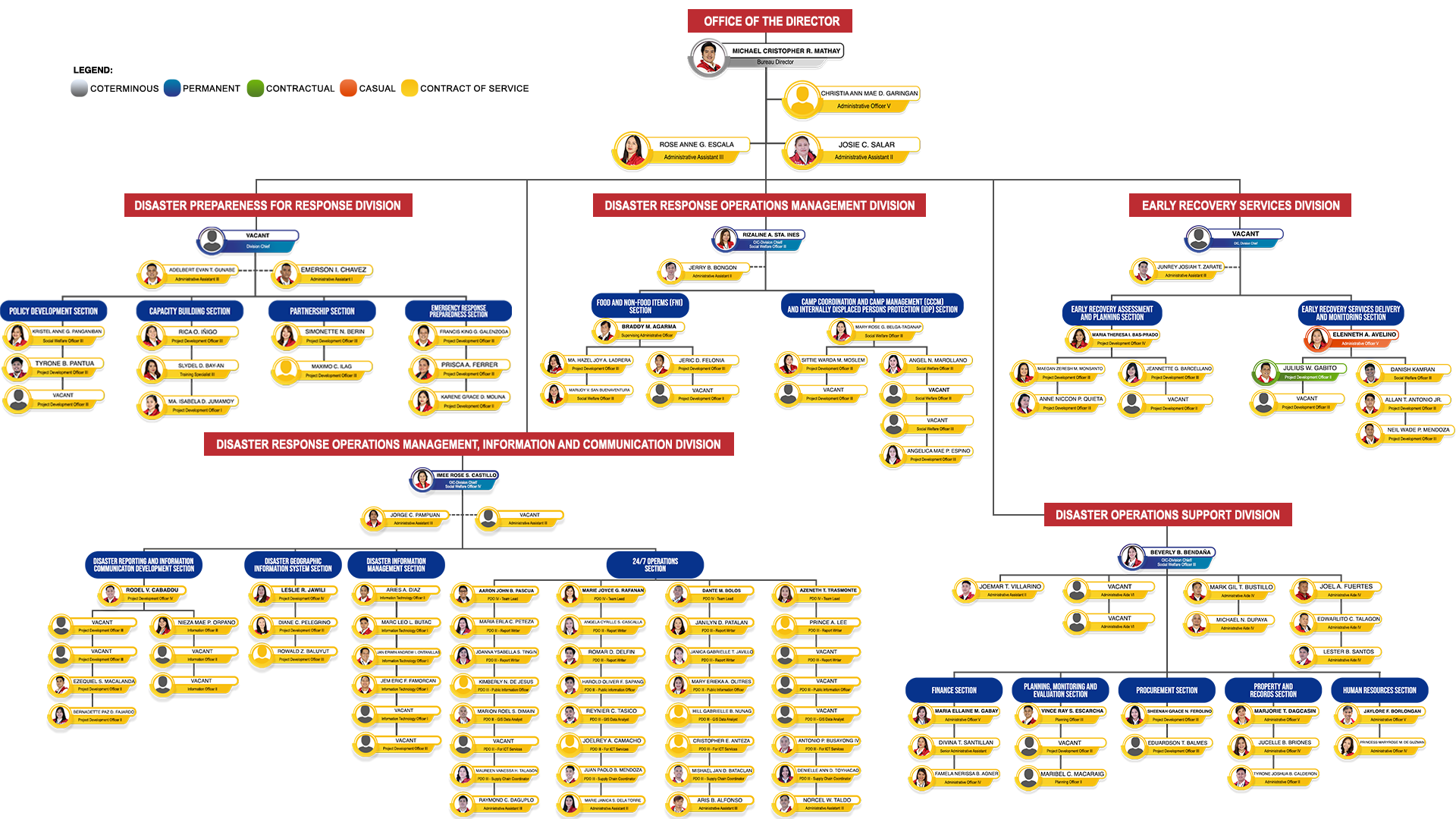
The Disaster Response Management Bureau is mandated to provide technical assistance and resource augmentation to the DSWD Field Offices (FOs) and stakeholders in the management of disaster risk reduction and management (DRRM) policies, plans and programs for disaster-affected families and communities in the context of social protection. Its functions give emphasis on the delivery of a coordinated disaster response in times of disasters and emergencies.
As Vice Chair for Response and Early Recovery Pillar of the National Disaster Risk Reduction and Management Council (NDRRMC), DSWD is mandated to ensure that the response of the Philippine Government as a whole to disasters is well-coordinated, follows established protocols, and is clearly communicated to the public. The Department also performs as the cluster lead of the Camp Coordination and Camp Management (CCCM), Internally Displaced Person (IDP) Protection, and Food and Non-Food Items (NFIs) clusters.
Mission and Vision
Vision
Enhanced resiliency of Filipino families and communities on disasters and climate change, have secured and equitable access to basic services toward sustainable development.
Mission
As lead of the country’s Disaster Response and Early Recovery Pillar, the DRMB shall steer in the management of innovative response, early recovery, and other risk reduction policies and programs through a whole-of-nation approach.
2028 Vision Basecamp: A desired whole-of-nation approach in disaster preparedness for response, reducing risks and enhancing the resiliency of Filipino families and communities on disasters and climate change towards sustainable development.
History
2004
The Disaster Response Division was part of the Department of Social Welfare and Development – Program Management Bureau (DSWD-PMB), consisting of four units: Preparedness, Response, Rehabilitation, and Disaster Response Operations Monitoring and Information Center (DROMIC).
2010
RA 10121 was enacted, renaming the National Disaster Coordinating Council (NDCC) to the National Disaster Risk Reduction and Management Council (NDRRMC). DSWD became the Vice-Chair for Disaster Response, leading the Food and Non-Food Items Cluster and the Camp Coordination and Camp Management and Internally Displaced Persons (IDPP) Cluster.
2012
DSWD Memorandum Circular (MC) No. 1 placed disaster-related response under the Risk Reduction and Management Program Division of the Protective Services Bureau. DSWD MC No. 25 created the Disaster Risk Reduction and Response Operations Office (DRRROO) to handle the Warehouse Management and Donation Facilitation Division and the Disaster Risk Reduction and Management Division.
2014
DRRROO remained under the Operations and Program Group, focusing on disaster response operations. DROMIC was placed under the supervision of the Assistant Secretary of the Office of the Secretary to expand its functions.
2015
DSWD Administrative Order (AO) No. 2 established the Disaster Response Assistance and Management Bureau (DReAMB) to enhance disaster response initiatives, merging DROMIC with DReAMB. The Warehouse Management and Donation Facilitation Division moved to the National Resource Operations Office (NROO) under the DSWD General Administration and Support Services Group (GASSG).
2018
DReAMB evolved into the Disaster Response Management Bureau (DRMB). The Disaster Response Management Group (DRMG) cluster was created, placing DRMB and the National Resource Logistics and Management Bureau (NRLMB) under this cluster.
2024
The Disaster Response Command Center was established as a central hub for coordinating and executing disaster response initiatives. Utilizing state-of-the-art technology, it features dashboards that showcase detailed data on displaced populations and maps pinpointing DSWD warehouses along with inventory levels, enabling real-time analysis to comprehensively monitor disaster situations.